Henry N. DeMenil in China (1907-1908)
from The North-China Herald
About the source for the story
The North-China Herald was the official record of the British Supreme Court for China and Japan and the British Consulate. In the mid-1800s it was the most influential newspaper in China. For much of the period it was published under the masthead North-China Herald and Supreme Court and Consular Gazette. In 1907, the paper covered the trial of an American, Henry DeMenil, accused of manslaughter in the death of a Tibetan Buddhist monk or lama. The account seems to be two-thirds a verbatim account of testimony and one-third summary. The text has been edited for clarity and to modernize some spelling and punctuation.

Here starts the testimony of Henry Nicolas DeMenil in his trial for manslaughter
DeMenil stated that he was a physician and surgeon and had studied at Boston University for four years before he was admitted to practice at St. Louis, Missouri in 1903. He had practiced in Saint Louis, Japan, and China. He was invited to China by a high official. For five months he remained at Tientsin teaching in the government school. Temporarily he was a teacher of English and chemistry at the YMCA.
He left Tientsin in November last year proposing to go to Chengdu in Szechuan. he had been offered the position of teacher by the highest Chinese families who paid his expenses from Japan to Szechuan. He stayed at Loh Ta-ren’s yamen as a guest in Chengdu.
He received an appointment in a small private school and remained there for about three months during which time he was in communication with the American Consul in Chungking. He afterwards decided to leave Chengdu because he could not make a living there. He was unable to get the position in the government school because he was not backed up by the Council and he lost all his private pupils.
He wrote two letters to the Consul in one of which he declined to hand over his passport because there was too much red tape about it. The 2nd letter announced DeMenil’s intention to go to India without a special passport owing to the delay in receiving it.
He bought a lot of foreign medicines some merchandise and two horses and left Chengdu bound for India. He intended to travel and learn something of the country and of the diseases of the people. He also wished to collect some Tibetan beetles and to write a book upon and explore the country.
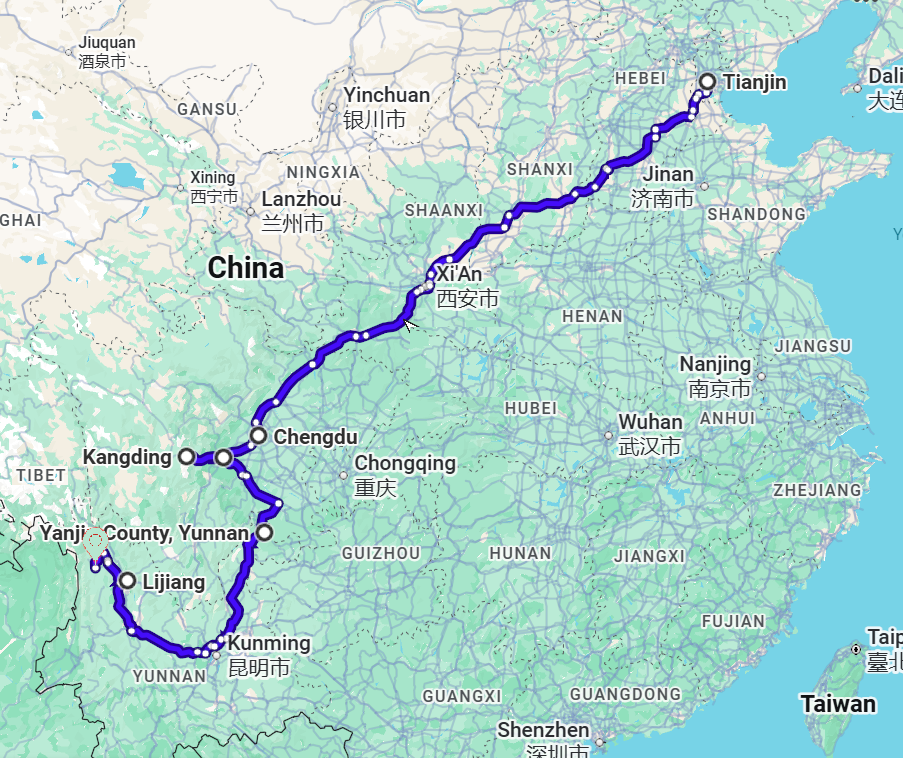
When he was engaged upon philanthropic work treating people for diseases and wounds. Occasionally he was paid 30 or 40 rupees [yuan?] in cash. He made no charges, but he was voluntarily paid this money. He treated many hundreds of people on his journey. He treated malaria, colds, toothache, headache, intestinal complaints, etcetera. Frequently he gave surgical treatment.
Occasionally someone paid DeMenil in rupees. By this money and trading he succeeded in paying all these expenses. His medical treatment was meant to win the friendliness of the people. He then described his journey.
When he got to Yachou about four days journey from Chengdu, his escorts (see below) took him by mistake to the house of an American missionary. From him DeMenil obtained direction to a Chinese inn a day's journey further. He received a message from this missionary to the effect that the Consul, Mitchell, was going to Tatsienlu and that if DeMenil remained, they could travel in company. DeMenil was staying at a dirty Chinese inn, and he wrote back to the missionary to say there was no reason for him to wait several days. He waited all day for a reply and then went on to Tatsienlu which he reached about two weeks after leaving Chengdu.
He stopped at a Tibetan inn there and remained four or five days and during that time two mails came in. As the American consul did not arrive, DeMenil left and went on to Batong and on to Yanji. Then he went to Artungza.
He passed through very mountainous and desolate country. Two Chinese soldiers, who had been furnished by an official at Yanji, acted as his escort.
These soldiers, from the time they left Yanji, did not appear to be friends and quarreled a great deal. In leaving Yanji in the morning one of the soldiers told DeMenil to carry a sword for protection. The soldiers carried rifles and cartridge belts.
The country seemed to be in a state of revolution. A rebellion was in progress, and the country was full of robbers and wild animals.
[Editor's note: British and Russian maneuvering in 1907 officially recognized Qing suzerainty over Tibet, although direct Qing imperial rule wasn't established in Lhasa until 1910.]
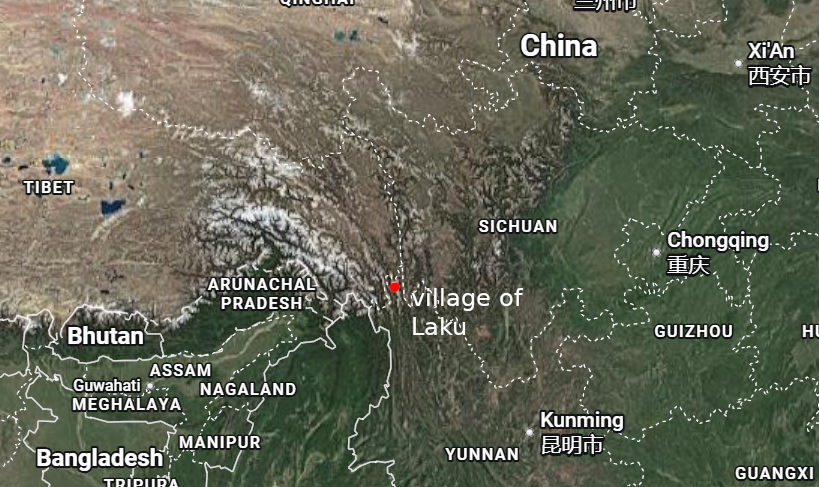
Henry arrived at Laku a place in the mountains about 16,000 feet above the sea and composed of 5 or 6 little stone hovels at night, appearing it was either in Tibet or on the borderline.
[Editor's note: In 1907, Laku was a small village largely occupied by the Lahu people in the mountainous fringes of western China, located in modern-day Yunnan. It is now named Weixi.]
They stayed in a two storied house which he presumed was a hotel.
Cheng, one of the two soldiers, accompanied DeMenil. They walked upstairs to the room he was shown. His baggage was brought up by Cheng and a Tibetan man. Li was not present at the time; Li always left Henry and Cheng on the road. DeMenil did not think Li was doing his duty.
Cheng put his gun up against the wall of DeMenil's room and left it there. Then Cheng went downstairs. Li came upstairs about an hour after DeMenil had arrived at the inn. Li also put his gun in the room and went downstairs. Neither soldier asked for his gun. They could have taken them, had they wanted to.
At dawn next morning DeMenil got up as he had to make a long stage before nightfall. The baggage was packed up and DeMenil ate his breakfast. Li came up while the DeMenil was eating his breakfast and said something about his gun. DeMenil asked him if he wished him to carry his gun for him as they found the altitude very trying, and DeMenil had sometimes been over 20,000 feet above the sea. Li answered in the affirmative and picked up some of the baggage and took it downstairs.
Cheng took his gun and cartridge belt down. Everything was taken down except Li's gun and belt. As DeMenil was the last person to leave the hotel that day, he carried them down with him.
DeMenil was half awake and half asleep when he got down. Cheng began to call to someone and then Li came into sight 15 or 20 yards beyond the horses. DeMenil saw he was running away again, and as he was very much afraid of these Tibetans, DeMenil beckoned to Li to come back. Cheng and Li spoke together and DeMenil then scolded Li in English.
Li laughed at him and DeMenil took the gun and made a demonstration with it. Li got afraid and ran away. Cheng and DeMenil laughed at him. Li ran away straight to the rear, turned to the left round the horses and corner of the wall, and disappeared.
Then Cheng and DeMenil walked down to the corner of the wall. He saw Li at the next corner. Li dodged round the next corner and then stood in full view and then disappeared again. DeMenil walked back and stood in front of the hotel and loaded the gun.
He thought he would try it to see if he understood his mechanism. DeMenil desired to fire it so that he could use it if attacked by men or wild animals.
He fired off the gun to the right of him into the air taking care not to hit horses or the Tibetan man at the corner; then he unloaded the gun. He saw Cheng up above him laughing and nodding his approval. He continued to do so while while DeMenil reloaded the gun.
Turning to the left Henry saw a stone wall, some horses, and trees. He fired the gun to the left after taking care not to hit the horses. Then he heard someone scream on his left. He thought it was a woman.
He unloaded the gun, loaded it again, and was about to shoot when Cheng signed to him not to do so. He saw the cattle around him and thought he had better not shoot again. He walked to the left and saw some cattle and a mule grazing which ran away when it saw him.
It was misty that morning and somewhat dark. DeMenil saw a Tibetan on the ground. From where he was standing when he fired, he could not have seen this Tibetan. Neither shot was fired in anger and he never struck Cheng. When DeMenil saw the body he left the place at once. Cheng induced him to do so.
He did not see Li again that day. DeMenil walked up to the body and remained there a second. He could not see whether he was dead. He thought his bullet might possibly have struck him. The body was over 50 yards away from where witness stood when he fired.
He was completely unnerved at the time, suffering from mountain sickness. He was completely "gone." DeMenil thought Cheng made a statement to the Chinese authority atnearby Artungza. DeMenil was summoned to the yamen, and he surrendered the gun there.
[Editor's note: a yamen is the official residence and administrative office of a local bureaucrat or mandarin in imperial China. It functioned as the central hub for governance - handling tax collection, local public works, and judicial cases. The modern name or exact location of Artungza is unknown!]
Cheng and some Tibetans were there.
At this point witness broke down and Mr. Fleming, DeMenil's defence counsel, asked for a short adjournment while his client recovered.
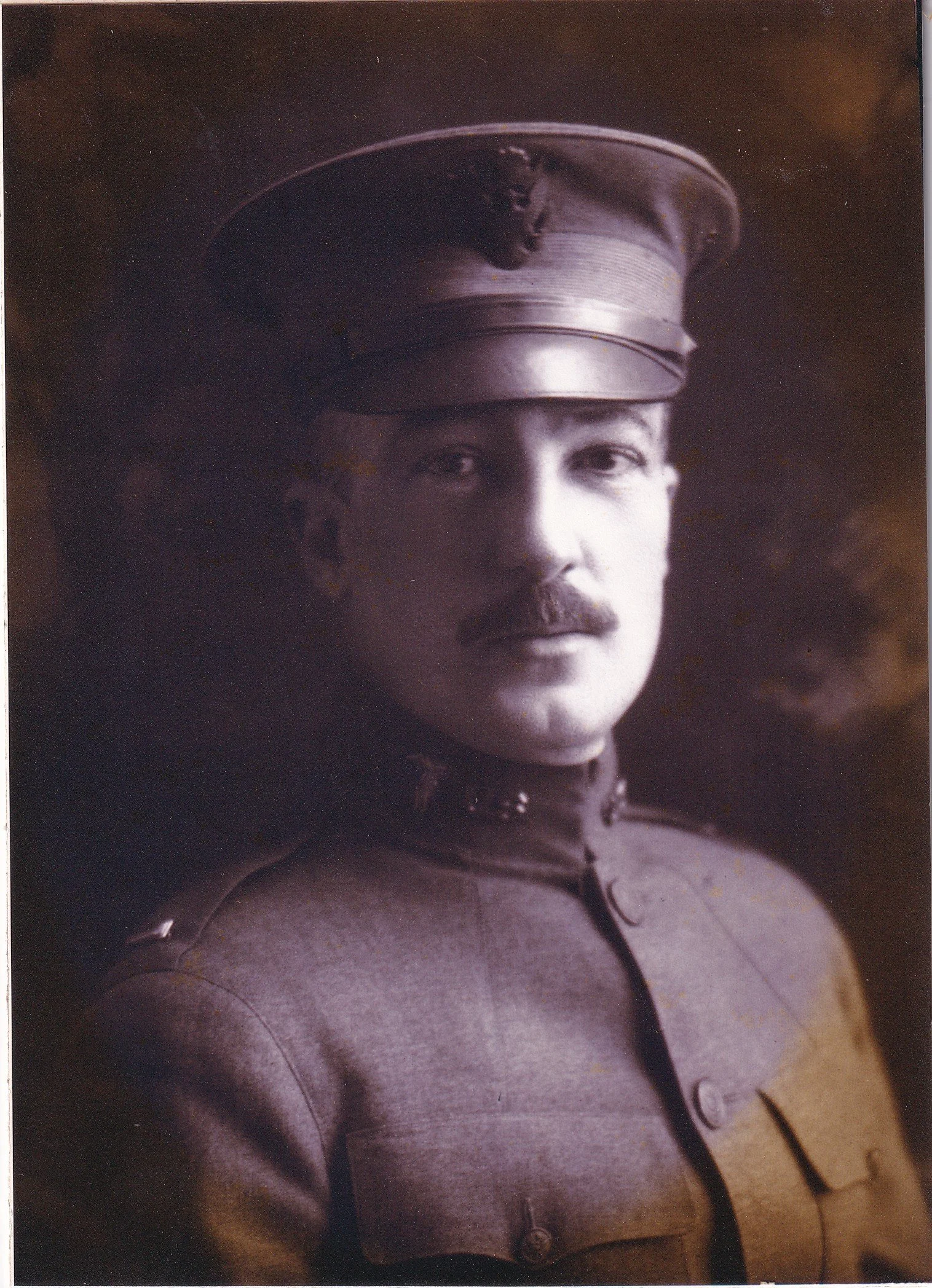
Dr. Henry DeMenil in 1918 at the end of WWI, a decade after his adventures in China
On resuming witness stated that the Chinese authorities at Artunza discharged him saying that he had shot and wounded a Tibetan accidentally, but that if he had signed a paper he would be allowed to go free.
Shown his diary DeMenil stated that he wrote the entry quoted by the District Attorney three or four weeks after the event. He was too much broken up to do so at the time. He wrote it up merely as a story. He never thought at the time that it would be doubted that it was an accident. It was then his intention to write a book.
Where the diary differed from his present evidence it was because he had incorporated suggestions made by the Chinese as to the accident.
DeMenil slept well the night before the affair and he did not awake angry with his Chinese soldiers. He did not see a bullet wound in the Tibetan's eye. The entry in the diary was put down as the material for a story.
[Editor's note: the contents of the diary entry refered to is not made clear in the North-China Herald report.]
DeMenil went from Artunza to Likiangfu, a two weeks journey, where he was stopped in response to a telegram from the Chungking consul ordering DeMenil to be found, bound, and brought to Chungking.
He had been tried in Artunza by Chinese officials and, as far as he knew, after 28 days they were satisfied that it was an accident.
They said they could not keep their promise to free him because the American consul had ordered them to send him to Chungking. It was six weeks journey to Chungking from Likiangfu. The traveling was very bad and witness was very weak when he arrived in Chungking.
DeMenil reiterated that from Chengdu to Tatsienlu he carried foreign food. After that he had to live on Tibetan food. There were rugged unpopulated mountains around Laku.
When he fired Henry had no intention of firing at or intimidating anyone. He was merely trying the gun. Cheng abused Li for having kept out of sight the previous day. DeMenil understood that it was Cheng's statement at Artunza that cleared him.
DeMenil had never before fired a gun in his life. He was a city bred man. That morning he considered it was necessary to learn how to use the gun. At Chungking Consul Mitchell did not examine the Chinese in witness' presence. He was not informed of his right to have an attorney, and any statements he made then were made under compulsion. The Consul was the most contemptible character DeMenil had ever met.
This ended the accused's testimony.
Judgment in the case was given 3 weeks later, on December 2nd, 1907
The physical condition of the accused at the time of the shooting was bad and was aggravated by the rarefied mountain air of the locality, the loneliness of the place, and the wildness of his surroundings. This being so, it is not surprising that he showed that he should become irritated on account of the improper conduct of one of his escorts. However, when we consider that the lama who was killed was unknown to the accused, that the first shot was fired for the mere purpose of intimidating Li, and not with a view of hurting him, and that the surrounding circumstances were such as to affect seriously the nervous condition of the accused, the conclusion is irresistible that the shooting which caused the death of the lama was without the slightest criminal intent.
This leaves to be considered the question of whether the conduct of the accused was of such a careless nature as to render the act complained of criminal in the eyes of the law. We are of the opinion that it was not.
The hamlet of Laku consists of only four or five huts that is situated on a high mountain in a sparsely settled country. The road upon which the lama was traveling was higher than the place where the accused stood when he fired the shot, and he testified that this fact had not been previously observed by him. The testimony shows that there were trees intervening between the lama and the accused at the time the fatal shot was fired, and it is doubtful whether the lama was in sight at the time. Had the shots been fired in a village located in the thickly settled portion of China, defendant's conduct would be characterized as criminal carelessness.
All of the evidence goes to show that the accused has hitherto borne a good name and that he is a peaceable law abiding citizen. He was educated at Washington University, St. Louis, Missouri, and is a duly licensed practitioner of medicine. He has already been under arrest for a number of months and has suffered much inconvenience and pain.
He testified that he was arraigned before the Chinese courts at Artunza which, though not having jurisdiction, heard the evidence and reached the conclusion that the killing was the result of an accident.
In view of all of the circumstances, the court does not feel that the ends of justice would be subserved by imposing further punishment upon the accused.
He is therefore acquitted.
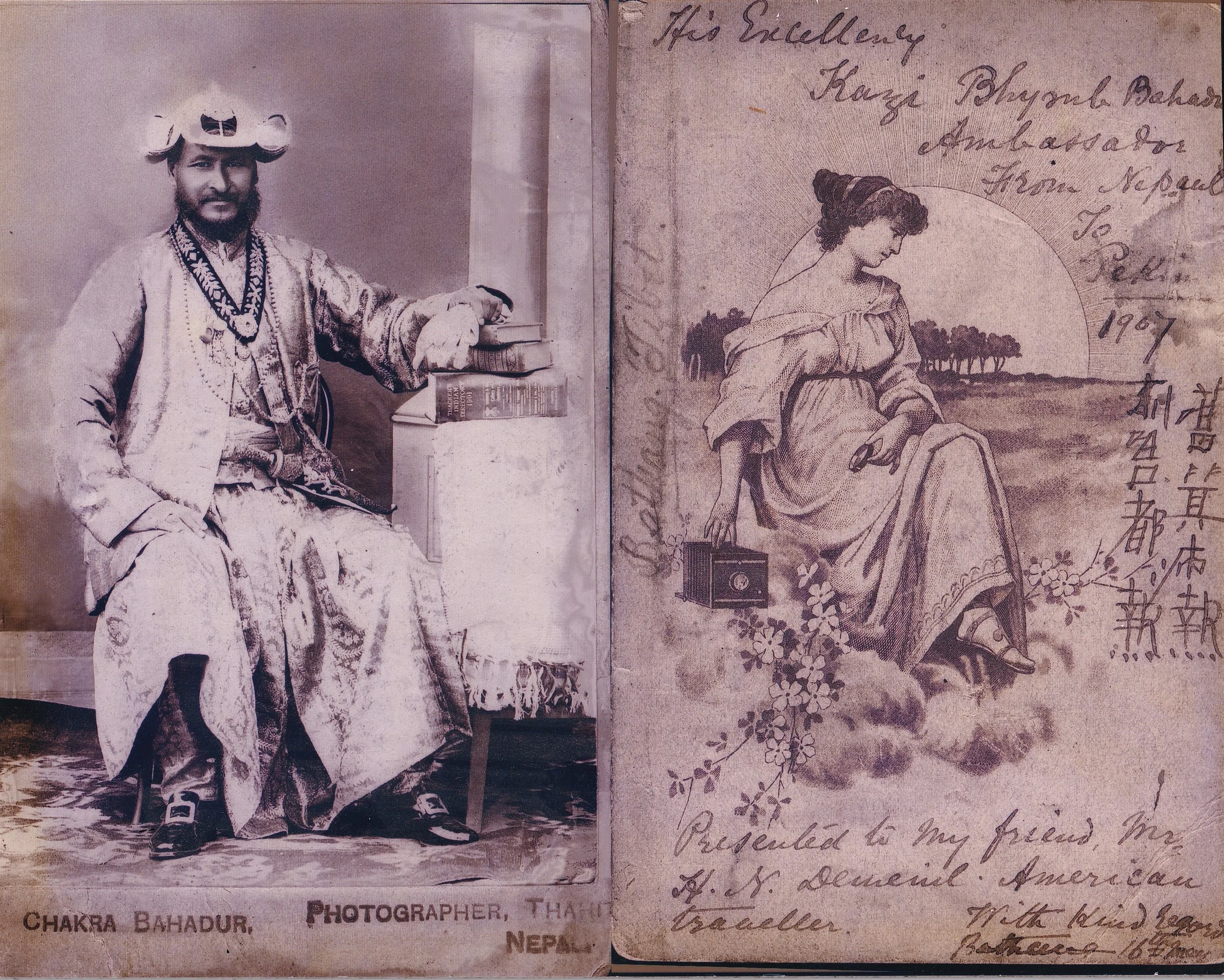
While in China and Tibet, Henry DeMenil met many officials, including the Nepalese Ambassador to China, Major Jit Bahador, who gifted him a photographic likeness with the inscription, "Presented to my friend, Mr. H. N. DeMenil, American traveller."
Our 130th Bastille Day Celebration
Photos by Joe Carpenter
On July 12th from noon until 3pm we held our annual Bastille Day celebration in our beautiful one-acre garden with a special reading of the Rights of Man, dedicated to the memory of Bill Hart, late of our Board, a singing of French National Anthem, La Marseillaise, music by the St. Louis based Parisian Jazz Trio Dizzy Atmosphere, a chance to fire a flintlock Charleville French Infantry musket hosted by Ray Naughton, and French themed food and drink.
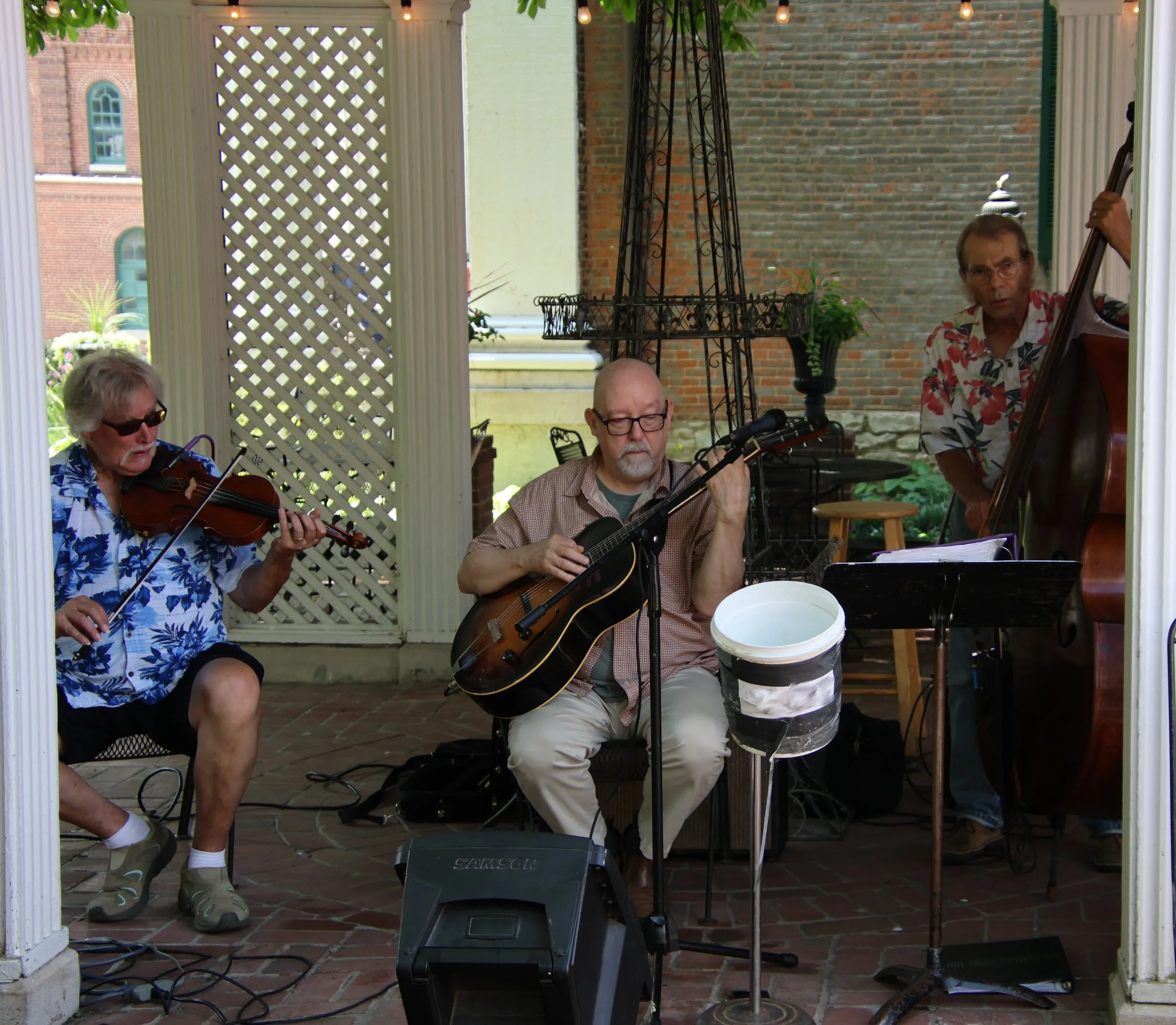
Dizzy Atmosphere Parisian Jazz Trio
Bastille Day celebrations in St. Louis in the 19th century were a time of great excitement and festivity. The French Revolution was a source of tremendous inspiration for many Americans, and Bastille Day was seen as a celebration of liberty and democracy.
The first Bastille Day celebration in St. Louis was held in 1803, just after the Louisiana Purchase. The event was organized by a group of French immigrants and included a parade, speeches, and a fireworks display.
In the years that followed, Bastille Day celebrations in St. Louis became increasingly elaborate. By the mid-19th century, the city was home to a large and vibrant French community, and Bastille Day was one of the biggest holidays of the year. The celebrations typically included a parade, a picnic, and a fireworks display.
Alexander DeMenil, the son of the builders of our beloved Chatillon-DeMenil Mansion, expanded his family’s leadership in the Bastille Day event, playing a prominent role over a period of four decades. In 1896, he organized the Sociéte du 14 Juillet, a group from the local French community dedicated to preparing for the annual celebration often held at Lemp’s Park (now Cherokee Park) located a block north of the mansion.
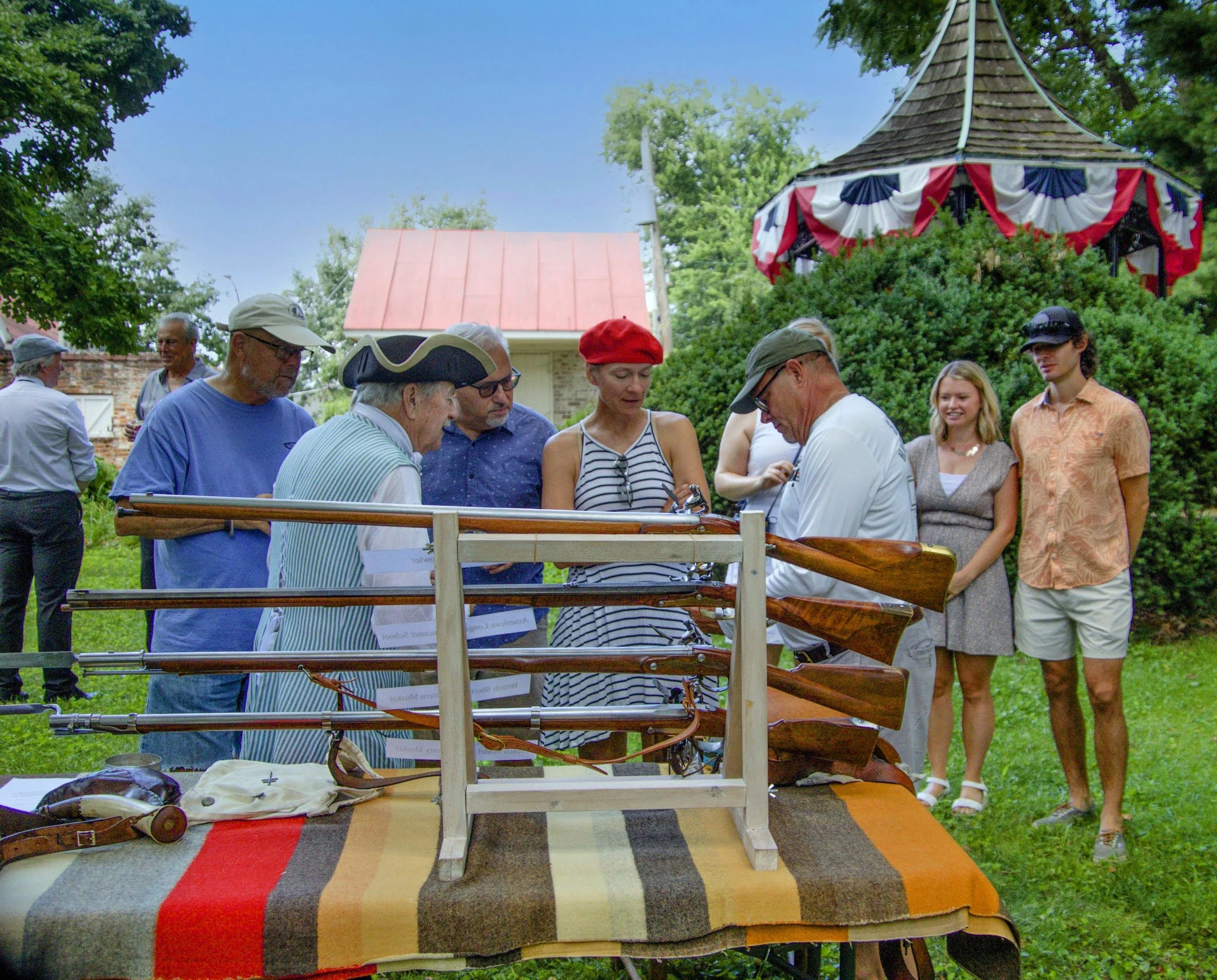
Ray Naughton with his exhibit of rifles of the Revolutionary War
Celebrations in St. Louis reached their peak in the late 19th century. In 1889, the city celebrated the centennial of the French Revolution with a massive celebration that included a parade, a concert, and a fireworks display. The event drew over 100,000 people and was widely considered to be one of the most successful Bastille Day celebrations in American history.
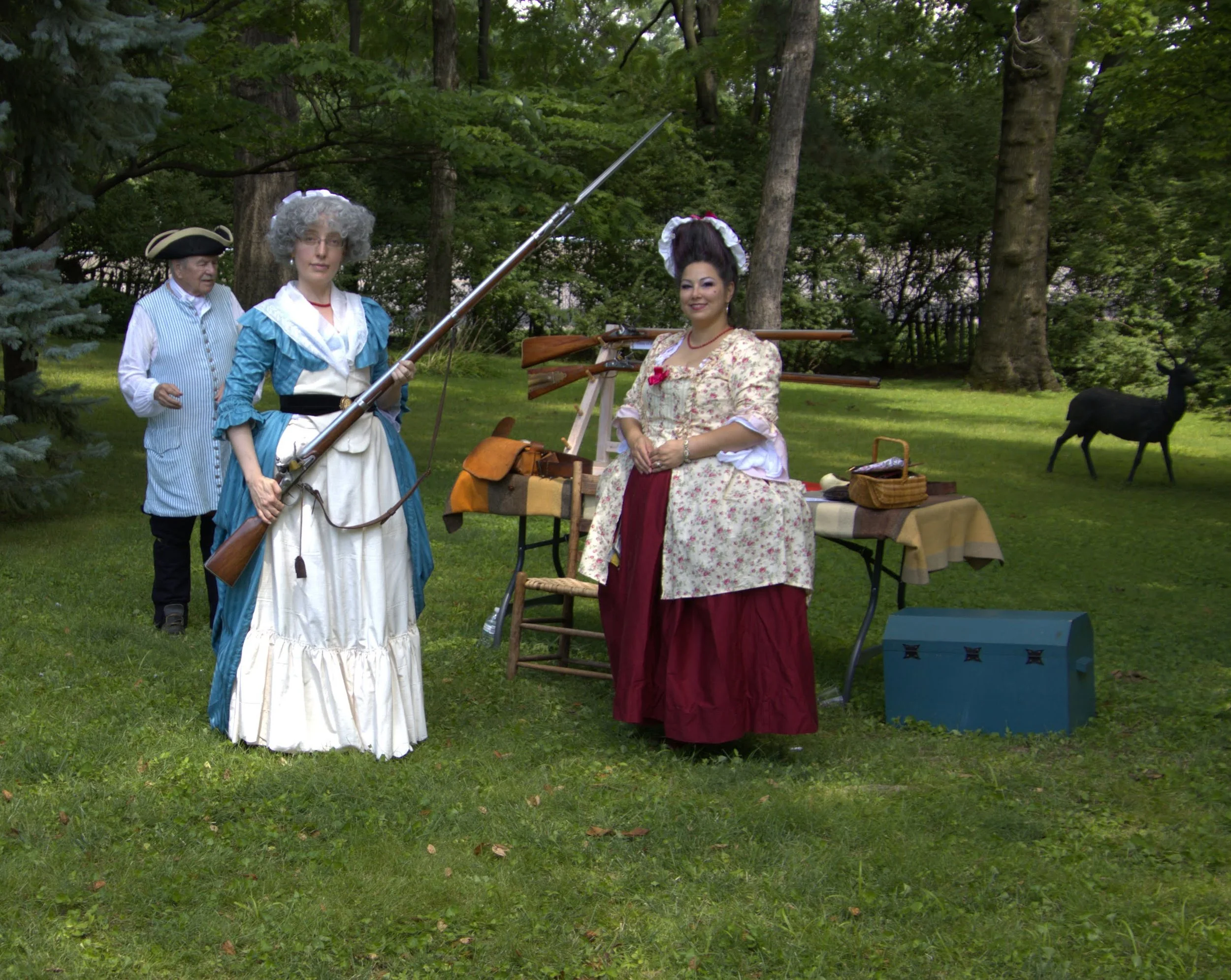
Ray and two Bastille ladies prepare to celebrate with a salute to Liberté, égalité, fraternité.
In the early twentieth century, both of Alexander DeMenil’s sons, Henry and George, joined their father on planning committees for Bastille Day.