Chanteau - Chatillon - Chouteau: Genealogical Chaos
by Irma Robinson Miller
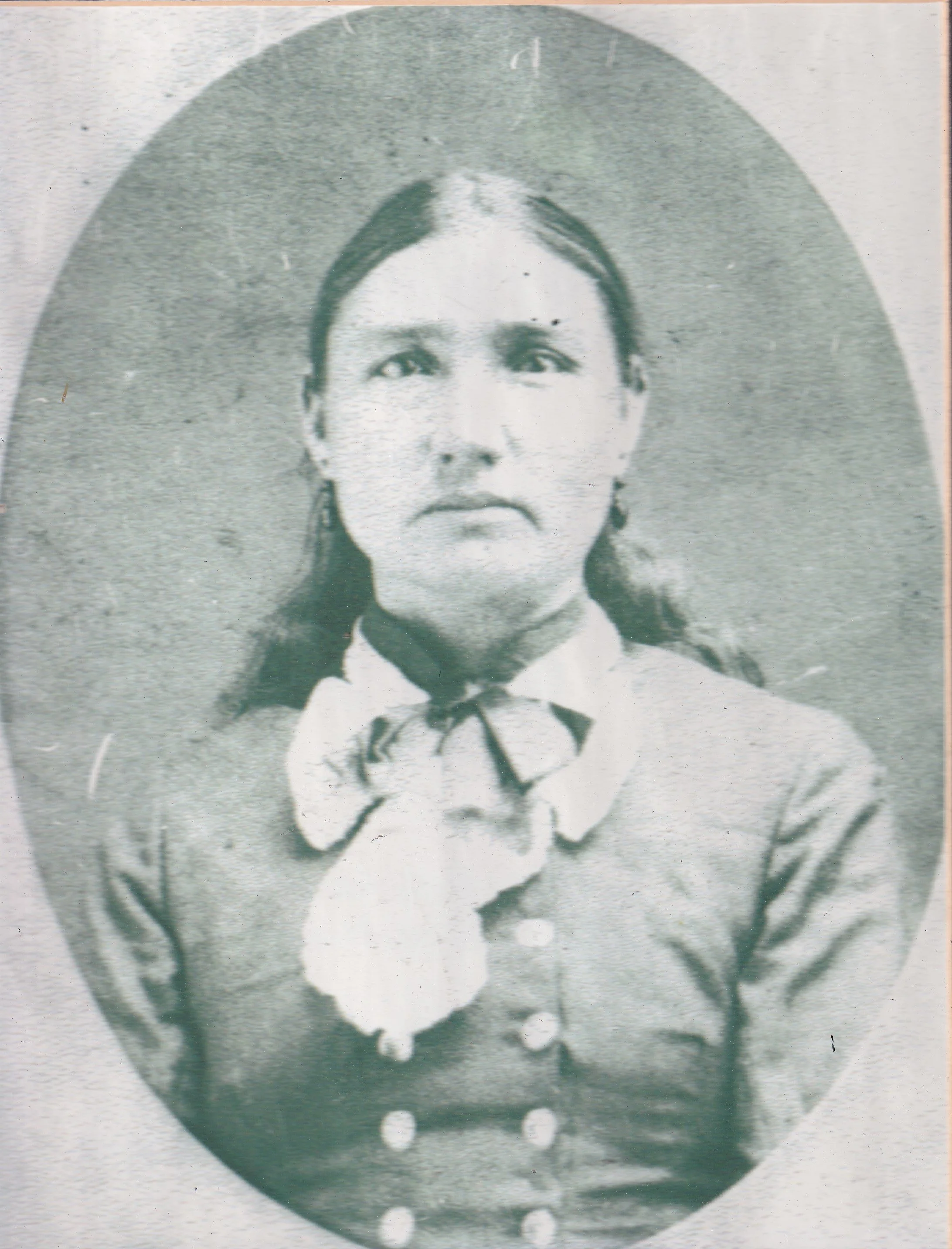
Emily Chatillon Lessert
The name Chouteau has long been synonymous with the Western frontier and the fur trade. With a famous French name for an ancestor, it seems a cinch to be able to find one Henry Chouteau whom family tradition claimed. My mother had been told by her grandmother, Emily Lessert, the following history.
Emily said that she was born about 1841 to a French father and a full-blooded Oglala Sioux Indian mother at Deer Creek near Fort Laramie, Wyoming. When she was a small child, her mother died. Her father, who was in the fur trade, took Emily to his good friend Joseph Bissonnette, who had an Oglala wife, to “raise” with his children. In her half French, half Indian English speech, Emily told her grandchildren that her father's name was Hillee Chanteau which the family interpreted to be Henry Chouteau. She was very fond of her father and had only the most pleasant memories of him.
When Emily was of marriageable age, she readily accepted her father's choice of husband for her. He brought Louis Benjamin Lessert, the son of Clement Lessert and Julia Roy of Kansas City, to Wyoming territory. She then made the long trip to St. Louis with her father to be married. After their marriage in St. Louis, they went to Walnut Creek, Kansas, then to La Porte, Colorado, before going to the Pine Ridge Indian Reservation in South Dakota where the Agency was established. The rest of the story I know very well, having been born and raised near the Pine Ridge Reservation. The Lesserts raised five children of which there are many descendants.
My mother was certain that, since there had been a close relationship between the Chouteau family, Emily's father, and the Lesserts, that her grandmother must indeed have been the daughter of a Chouteau. But grandmother Emily had pronounced the name with a different sound. She had inserted an N in the first syllable. In Louis Benjamin Lessert’s obituary, his wife's maiden name was stated as Emily Chanteau. And that she married him on New Year's Day in 1855 in St. Louis, while Emily's obituary said that she and Lessert were married at Deer Creek, Wyoming on New Year's Day 1858.
Armed with these contradictory statistics, my mother and I began in 1959 the search for Emily's identity. After several unsuccessful visits to the Missouri Valley room of the Kansas City Public Library, the hunt was abandoned. We could not find anything that would tie us to the founder of Kansas City as well as St. Louis, the Chouteau family.
In 1977 I resumed the hunt in earnest by reading every book that I could find on the fur trade and Fort Laramie. I went over the Chouteau genealogy until I knew all the Henry Chouteaus personally, but I could not place one in the Fort Laramie area at the time of Emily's conception or birth. Having been told that Sioux and most Indian genealogy was nearly impossible to trace before 1870, I avoided that line of attack as long as possible.
Finally, I wrote a letter to the Census and Probate office at the Pine Ridge Agency requesting information on Emily Chouteau Lessert’s ancestry. Their reply brought a pedigree chart with: #1 my name, #3 my mother’s name, #7 Ollie Lessert (my grandmother), and #15 Emily Shatilyout (Chatillon? or Chouteau)… this followed by the notation: “She was born about 1839, we are unable to find anything regarding her ancestry.”
The question mark after Chatillon caught my eye. The name was a complete surprise to me. The Shatilyout I chose to ignore. The pronunciation, I knew, had to be the key. Instinctively I knew that I had a solid clue in the Chatillon name. A French dictionary also gave me an insight (the only words of French I knew consisted of Maurice and Chevalier) as to why the name had confused the family in differentiating Chanteau, Chatillon, and Chouteau. To the unfamiliar ear and three languages spoken -- genealogical chaos.
After receiving the Agency’s pedigree chart… it became my obsession to find Henry Chatillon. In the many books that contained references to him, historian Francis Parkman’s Oregon Trail seemed to be the authority on most of the footnotes. I checked it out of the library. His name jumped out at me from the pages of Parkman’s book.
Parkman had gone to Fort Laramie in 1846 to get a firsthand look at the American Indian. In St. Louis, the Chouteaus had given him a letter of introduction to their trading posts and provided Henry Chatillon as hunter and guide. Henry arranged for the party to live with his wife's Sioux family in the Fort Laramie area, and Parkman had recorded the events which included the death of Henry's wife, his visit to Joseph Bissonnette, and the arranging for the care of his children. It was exactly as Emily had told her granddaughter many years before.
I travelled to St. Louis to search records. One of the two volumes of St. Louis Marriages published by the St. Louis Genealogical Society revealed a record of marriage for Emily Chatillon and Benjamin LaPorte on 3 January 1859.
On leaving the motel, I picked up a tourist guide to places of interest in St. Louis. The Chatillon-DeMenil Mansion was listed. In answer to my request for more information, I received a brochure. In the leaflet a paragraph described a painting in the house which was believed to be of Chatillon and his Sioux wife, Bear Robe.
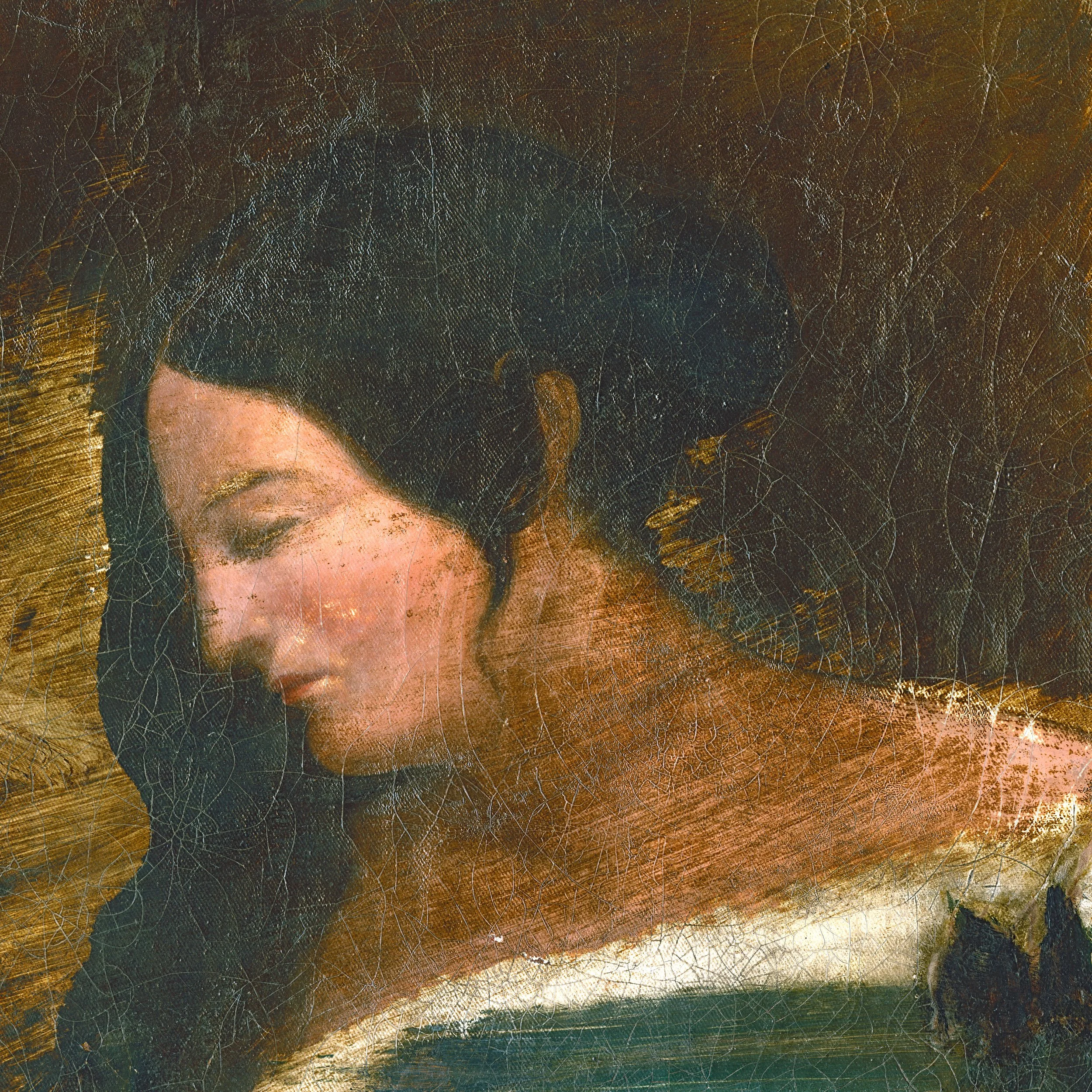
Bear Robe
The Oregon Trail edition that I had read did not mention Henry's wife by name. I checked out a later edition and indeed found that his wife was named Bear Robe and the events of her death in more detail. Another trip to St. Louis in September 1980 to visit the Missouri Historical Society, this time to look at St. Louis church records. Records of baptisms and marriages of Saints Mary and Joseph Catholic Church in Carondelet stated that Emily Chatillon of the Sioux tribe had been baptized on 31 December 1858. On three January 1859 she was united in marriage to Benjamin Lessert at the same church.
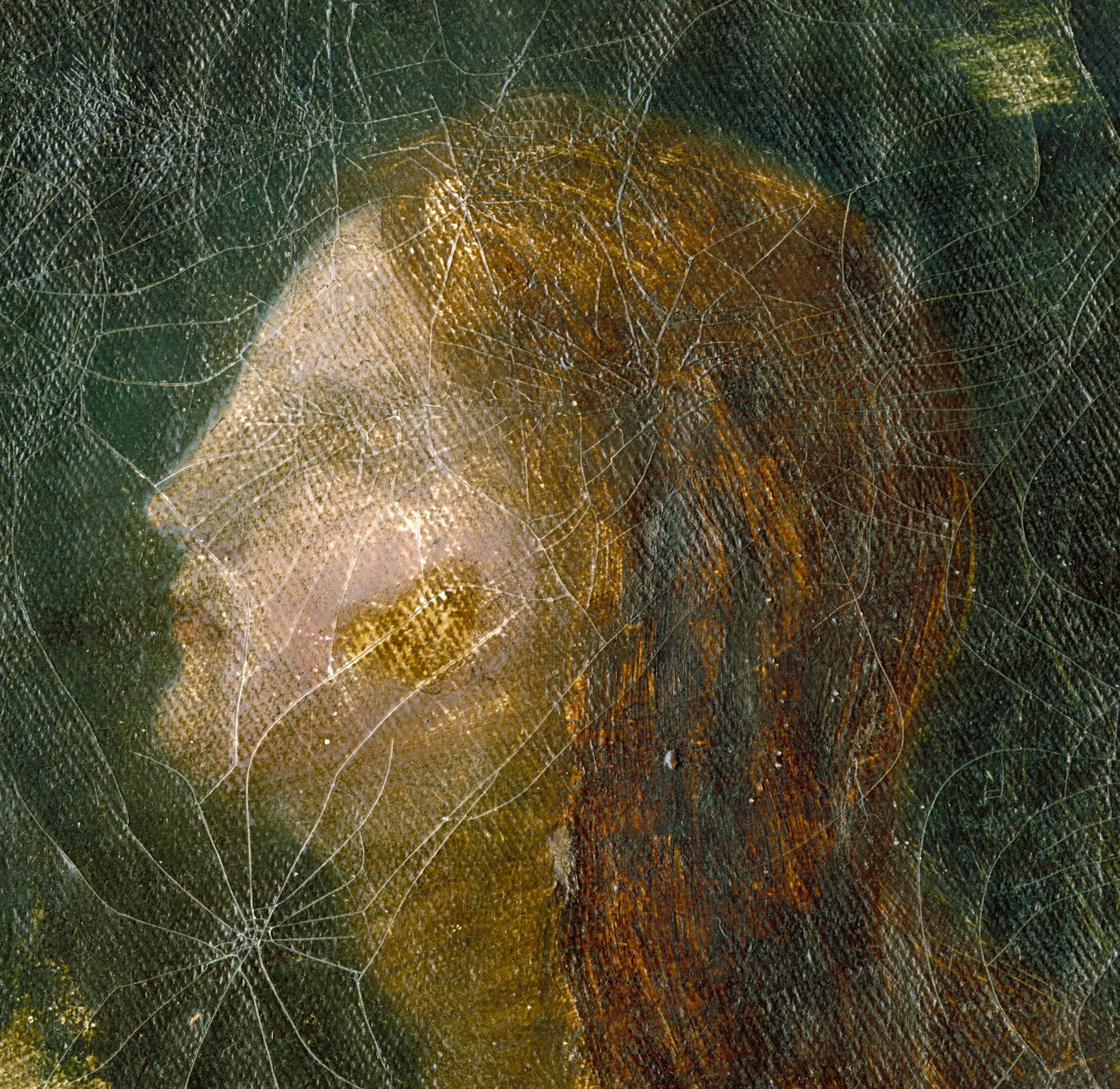
Emily Chatillon as depicted in the Bear Robe portrait
Epilogue: In Parkman's story of Bear Robe’s death, he made much of the fact that she was lame. A horse (as seen in her portrait) was killed and placed with her body for transportation in the spirit world. I have found a very interesting trait in the women of the family that coincides with this physical defect that Parkland states Bear Robe had. Bear robe was very lame. Emily, her daughter, was not. Susie, Emily’s second daughter, was very lame. Viola, Susie’s daughter, was not. Ilene, Viola’s second daughter, is slightly lame.
From the article CHANTEAU – CHATILLON – CHOUTEAU: Genealogical Chaos, by Irma Robinson Miller, published in the St. Louis Genealogical Society’s Spring 1981 Quarterly. Reprinted with permission.
The Quiet, Sporting Life of George DeMenil
George Shelley DeMenil (1890-1957) was a lifelong St. Louisan born into one of the city's prominent families. As the son of the well-known litterateur, developer, and supporter of French culture Dr. Alexander Nicholas DeMenil and his wife Bessie, George's life was intertwined with the city's history, from the grand preparations for a World's Fair to the urban renewal projects of the mid-20th century. His middle name, Shelly, was in honor of one of his literary journalist father’s favorite poets, Percy Bysshe Shelly.
A Privileged Youth
Born on July 12, 1890, George enjoyed a comfortable childhood. The family's wealth and social standing were evident early on; in 1899, the DeMenil family were significant financial subscribers to the upcoming World's Fair, with nine-year-old George personally listed for a $250 contribution. Newspaper clippings from the early 1900s paint a picture of a young man who traveled with his family, taking trips to Atlantic City and Saylor Springs, Illinois. By 1908, he was listed as a student living at the family's stately Greek Revival mansion at 3352 South 13th Street, now DeMenil Place.
Hobbies, Marriage, and Family Life
As a young man, George developed a passion for modern sporting pursuits. In 1915, he was an entrant in the Mississippi Valley Power Boat Association regatta with his 20-foot hydroplane boat, "Whiskers," which could reach speeds of over 33 miles per hour. In April 1917, George married Ida M. Good. The wedding was a quiet affair due to the illness of his mother. George and Ida went on to have two children, a son, N.N. DeMenil, who died in infancy, and a daughter, Marian A. DeMenil, who had a distinguished career as a mathematician and coach.
An Interest in Animals
Later in life, his interests turned to animals. He and his wife became active in the beagle club community, competing in field trials throughout the 1930s and 40s. His hound, Dem's Molly, was even named the outstanding sporting dog at the 1940 Second Annual Sportsman's Show. He also owned and bred horses, purchasing the thoroughbred C.S. Queenie in 1937, who sired numerous foals for him. His expertise in animal sporting competition was recognized in 1950 when he served as a judge for the St. Louis Beagle Club's annual pack stake event.
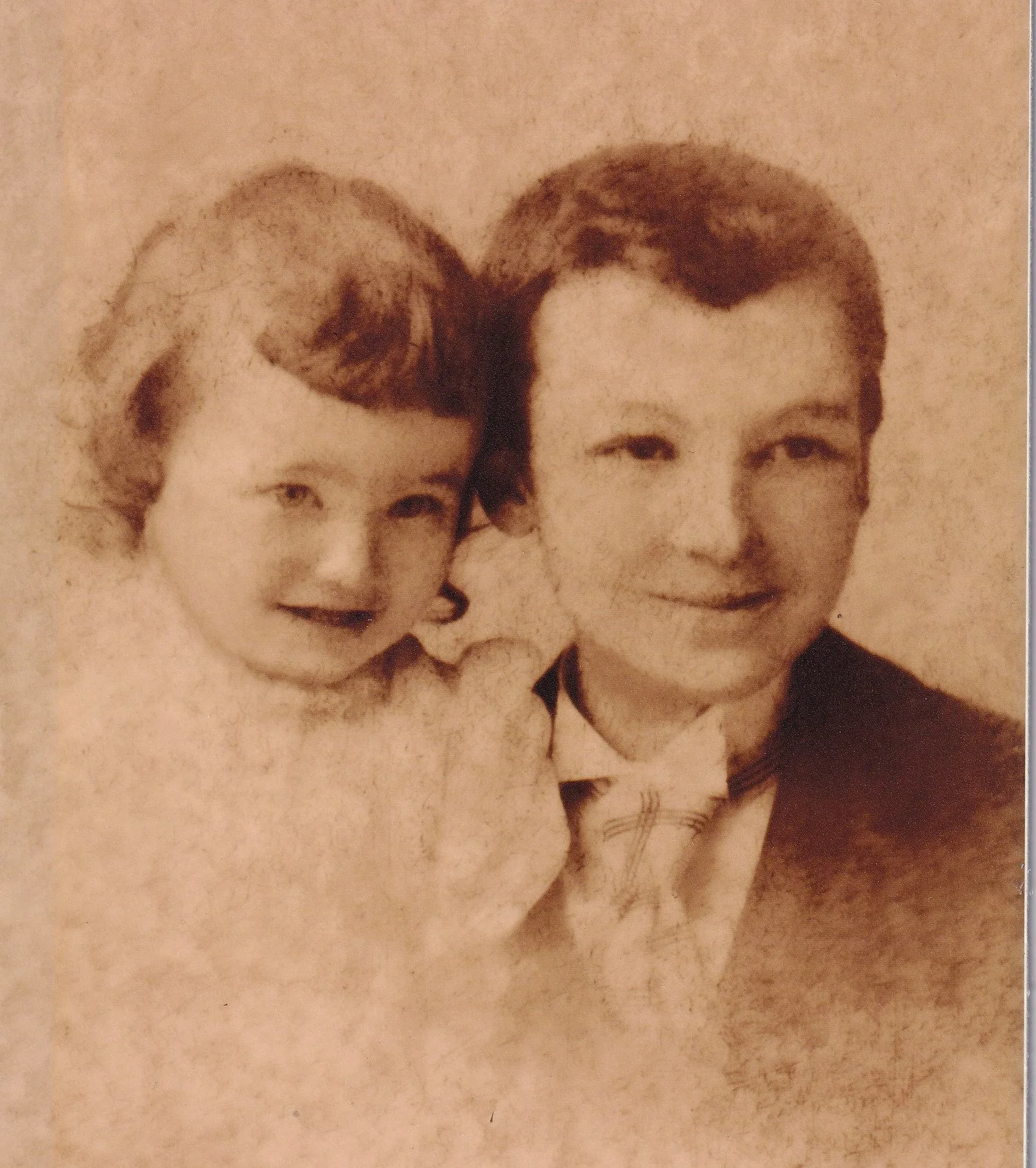
George (left) and his brother Henry
Inheritance and Real Estate
Upon his father's death in 1928, George became the administrator of a substantial estate valued at nearly $1.34 million. As one of the legal heirs, he received one-third of the estate, which included the DeMenil Building downtown and 23 parcels of real estate. He inherited the family home on 13th Street, but after living there for only a year, he and Ida moved to a new home on Pennsylvania Avenue. The area between International Shoe (the old Lemp Brewery which failed during Prohibition) and Anheuser-Bush had become heavily industrialized, and the shoe company had installed a tannery on their premises. George placed the 13th Street residence in the hands of caretakers, and it was operated as a rooming house until its eventual sale in 1945 to Lee Hess, who used part of the estate as the entrance to his tourist attraction, The Cherokee Caves.
The area around the DeMenil property is riddled with natural limestone caves, which were used for lagering beer (storing during fermentation) by the Lemp and other breweries in the 19th century. Opening in 1950, the attraction featured a museum of curiosities and tours of the vast caverns. A key part of the tour was the cave's path directly beneath the foundations of the house. The DeMenil House Foundation purchased the mansion from the state highway commission, saving it from destruction from the construction of Interstate 55. While Cherokee Caves were sealed by the highway construction, George DeMenil's boyhood home remains a significant St. Louis landmark.
In 1954, George and his family played a role in the changing face of downtown St. Louis. They sold two tenement buildings on Chestnut Street, which had been in the family since 1880, to the Land Clearance for Urban Redevelopment Authority. The sale, marked by a ceremony with Mayor Raymond R. Tucker, cleared the way for the development of Memorial Plaza which runs from Union Station to the Soldier’s Memorial along Market Street.
George S. DeMenil died of lung cancer on March 19, 1957, at the age of 66. The following year, his widow Ida and daughter Marian sold their residence on Pennsylvania Avenue and purchased a new home in Holly Hills from former St. Louis mayor Aloys P. Kaufmann.
Notes D'actualité
With winter in the offing, it was time to spruce up our public facing cast iron fence along DeMenil Place. After scaping, priming, and two coat of paint is a definite improvement on the before.
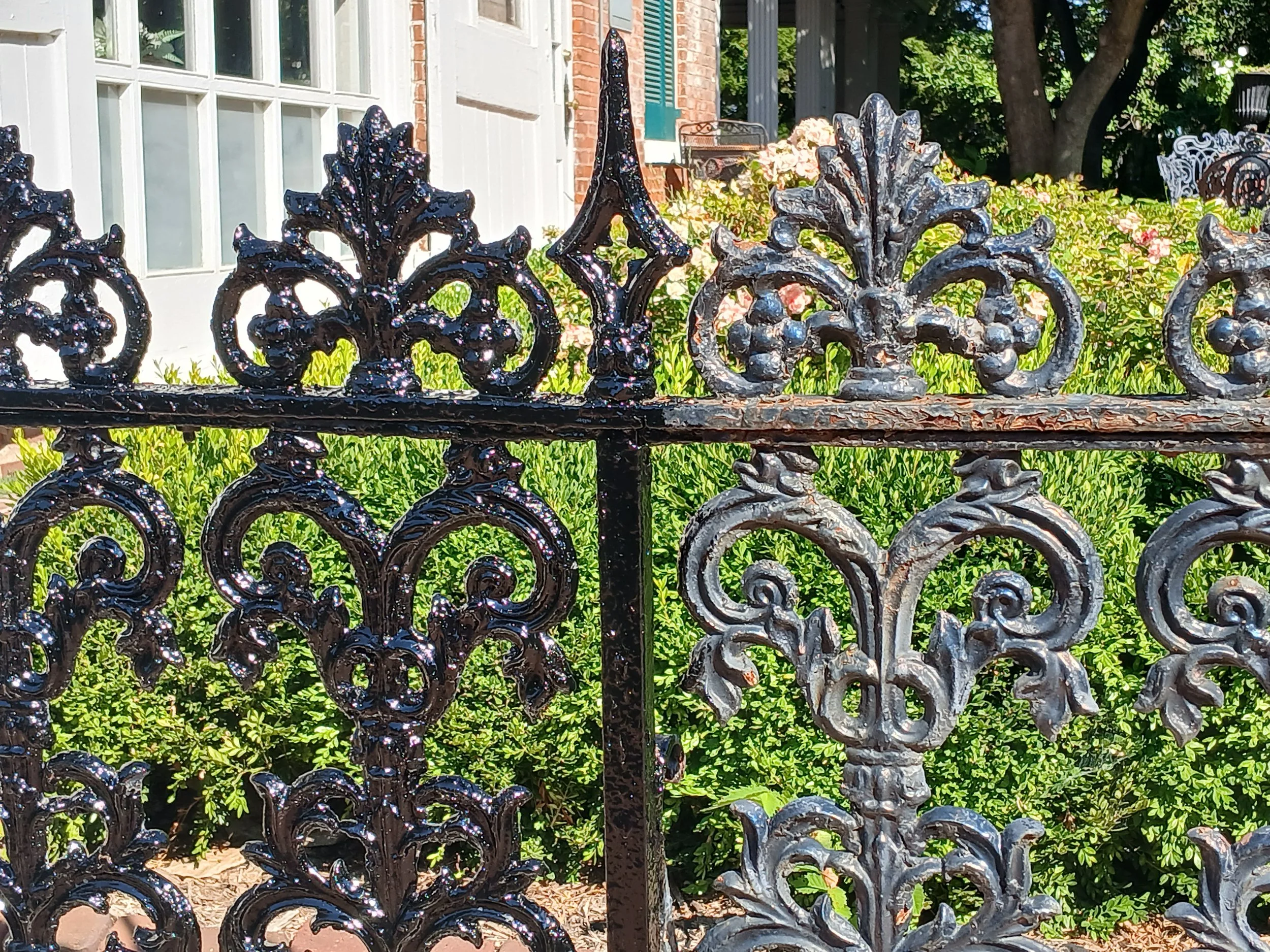
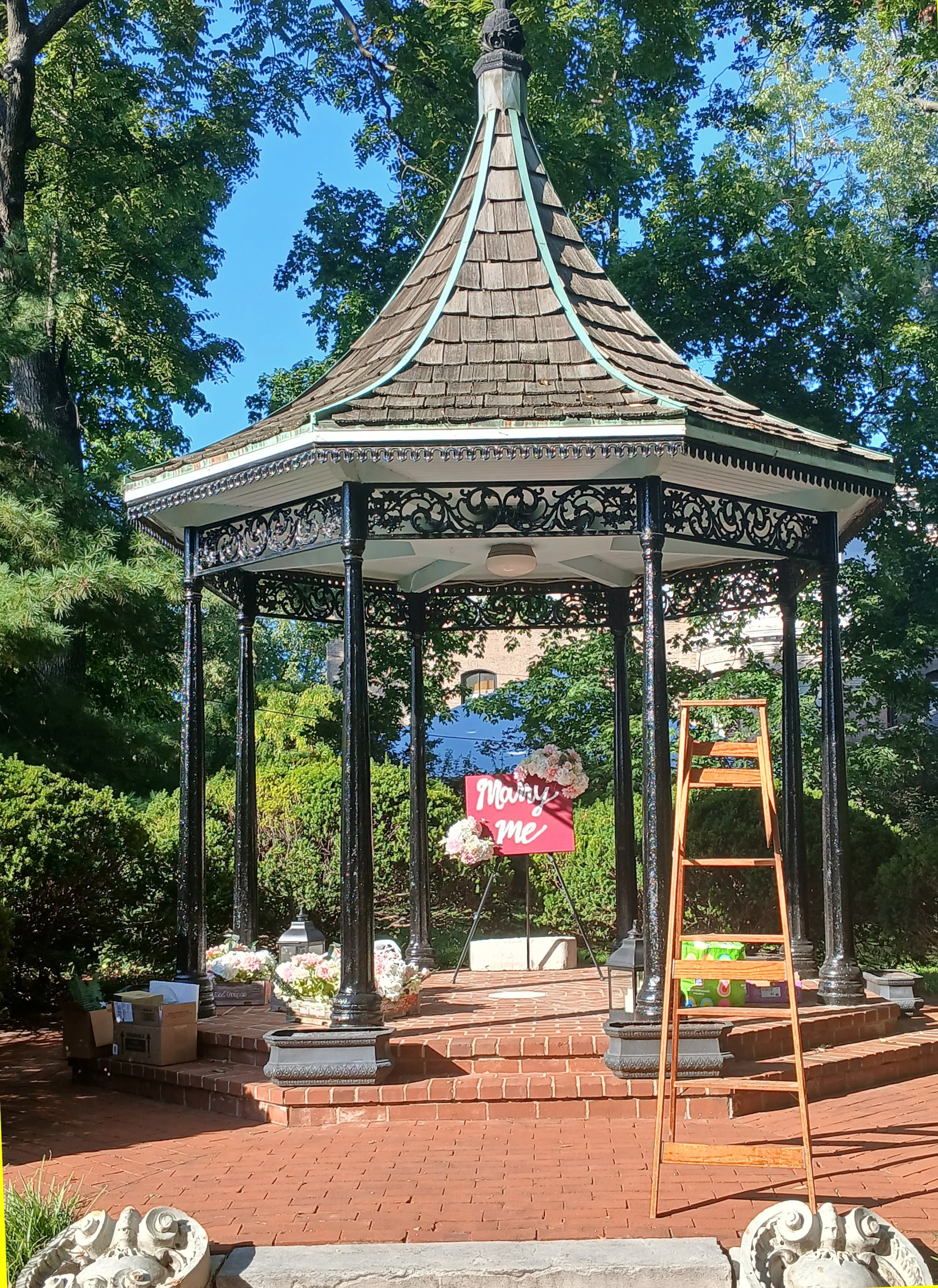
Once we saw how the new paint brought the front fence to life, we thought that the gazebo could use some love. We added some Haint Blue color to the ceiling to match the porches of the main house and the pavilion. Notice the detail of the iron work around the top.

A wonderful perquisite of our annual Bastille Day celebration in mid July is the chance it gives us to dress up! Not in wigs, corsets, and bustles, but in bunting and banners. This year's celebration profitably entertained members and the public with French style ham and cheese sandwiches (croques monsieur), tiny cups of vichyssoise soup, French Twists (vodka, lemonade, and sparkling water), the latest in French wines, Schlafly summer brews, and the music of the Parisian jazz trio, Dizzy Atmosphere.
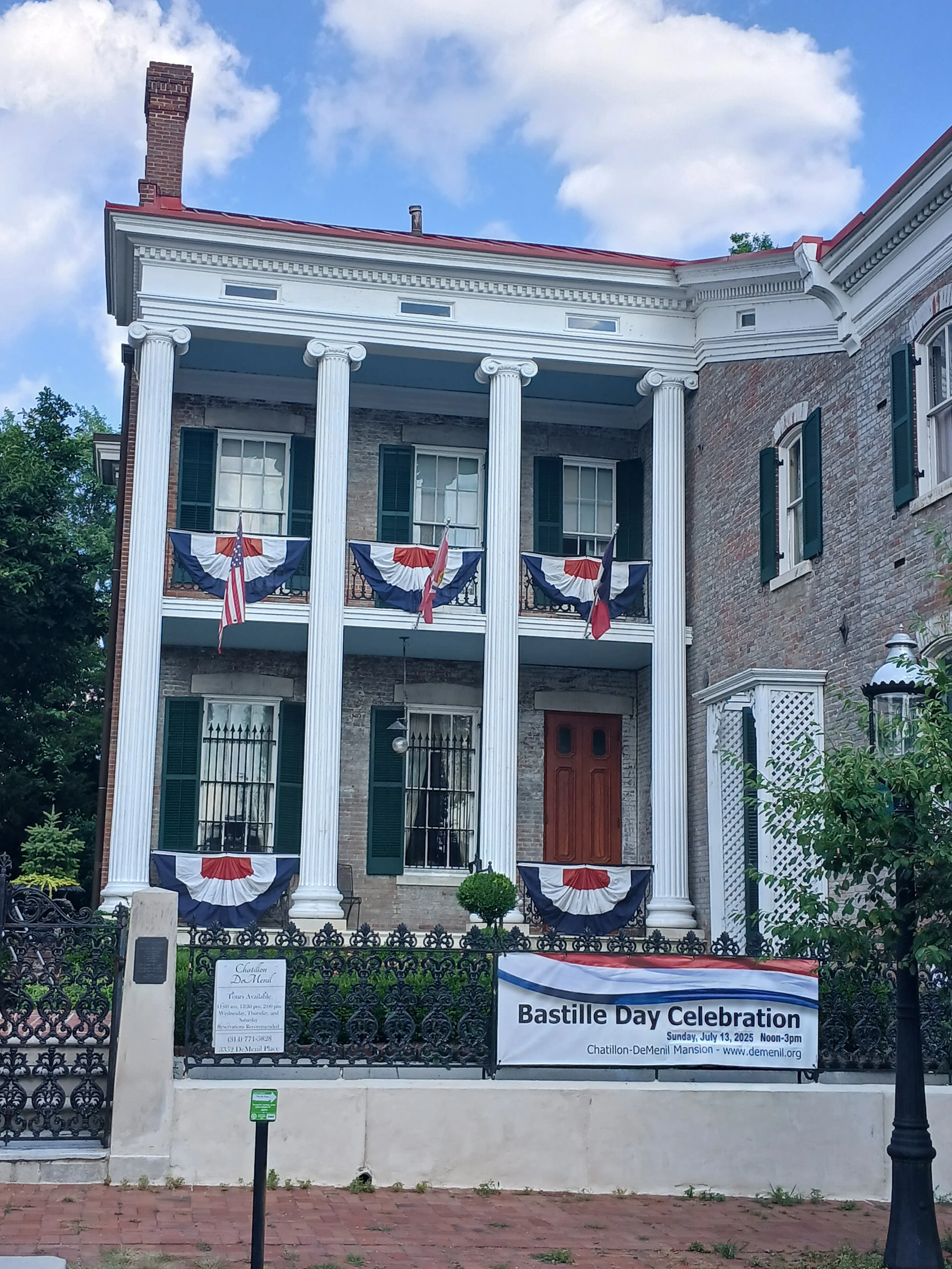
So far this past Spring and Summer, we have hosted a rehearsal dinner, two weddings, and a proposal, and we have reservations so far for four events in May through September of 2026.
Below is the gazebo dressed up for a surprise (!) proposal.